


Beyond the Screen: A Parent’s Guide to the "Great Rewiring"

It’s a quiet Tuesday night, but you can feel the tension through the bedroom door. You suspect your teen is caught in a loop of endless scrolling—or worse, a habit with pornography that feels impossible to break.
If you feel overwhelmed, you aren’t alone. Recent brain studies show that the "rush" a teen gets from short-form videos (like TikTok or Reels) activates the same impulse areas in the brain as problematic pornography use. These digital habits often act as gateways, but escalation isn't inevitable.
You aren’t powerless. The goal isn't just to "stop the bad stuff"; it’s to rebuild your teen’s attention span and protect their future joy. Here is how to move from conflict to connection by creating a Family Digital Contract.

1. Shift the Enemy: Reclaim the Digital Environment
The most effective way to start is to stop being the "policeman" and start being the "partner."
The "Haidt Entryway": Watch videos by social psychologist Jonathan Haidt (author of The Anxious Generation) together. Instead of lecturing, ask: "Does it feel like these apps were designed to keep you stuck?" This shifts the enemy from you to the predatory design of the apps.
The Friction Strategy: Use "Downtime" (iOS) or "Digital Wellbeing" (Android) to hard-cap "junk food" apps. Create a rule: Extra time on the phone must be "traded" for active digital time, like coding, digital art, or researching a hobby.
The 8 PM Wi-Fi Cutoff: When the internet goes off, provide a "dopamine bridge." Have a physical book, a complex puzzle, or a deck of cards on the table. This prevents the "withdrawal irritability" that leads straight to a relapse.
2. Rewire the "Urge" Response
Pornography and infinite scrolling often happen in a "trance." To break the circuit, your teen needs mindfulness tools.
The "HALT" Check-in: Teach them to pause and ask if they are Hungry, Angry, Lonely, or Tired before they pick up a device.
Urge Surfing: Explain that an urge is like a wave—it peaks and then subsides. If they can breathe through just 2 minutes of the "itch," the intensity usually drops.
Dopamine Fasting: Implement "Tech-Free Sundays" or two-hour blocks of no-input time to let the brain’s baseline dopamine levels reset.
3. Replace Passive Hits with Physical Wins
The brain needs a "win" to replace the "hit" of a screen.
Physical Mastery: Encourage activities with visible progress—weightlifting, guitar, or carpentry. The "slow-burn" satisfaction of mastering a skill is the biological antidote to instant gratification.
Long-Form Over Short-Form: If they love gaming, watch a two-hour documentary on game design rather than 60-second clips. This rebuilds the neural pathways required for deep focus.
4. Communication: From Interrogation to Connection
Shame thrives in silence. If a teen feels judged, they will simply become better at hiding.
The "Drive-Time" Chat: Heavy topics are easier when you aren't making eye contact. Talk while driving or walking.
Vulnerability Modeling: Be honest about your own struggles. Say, "I found myself scrolling for an hour today and I felt gross afterward. Do you ever feel that 'brain fog' too?" * Externalize the Problem: It’s not "your problem"; it’s "this challenge we are tackling together."
The Family Digital Contract: Your Blueprint
A contract isn't a list of punishments; it's a shared commitment to health. Your contract should include:
Phone-Free Zones: The bedroom is a tech-free sanctuary. Buy an old-school alarm clock so the phone isn't the first and last thing they see.
The Phone Basket: A physical spot where everyone’s phone (including yours!) goes during dinner and after 9 PM.
The "Wet Clay" Principle: Remind them that the teen brain is like wet clay. Using porn now carves deep grooves that make real-world relationships harder later. Frame the rules as "protecting your future self."
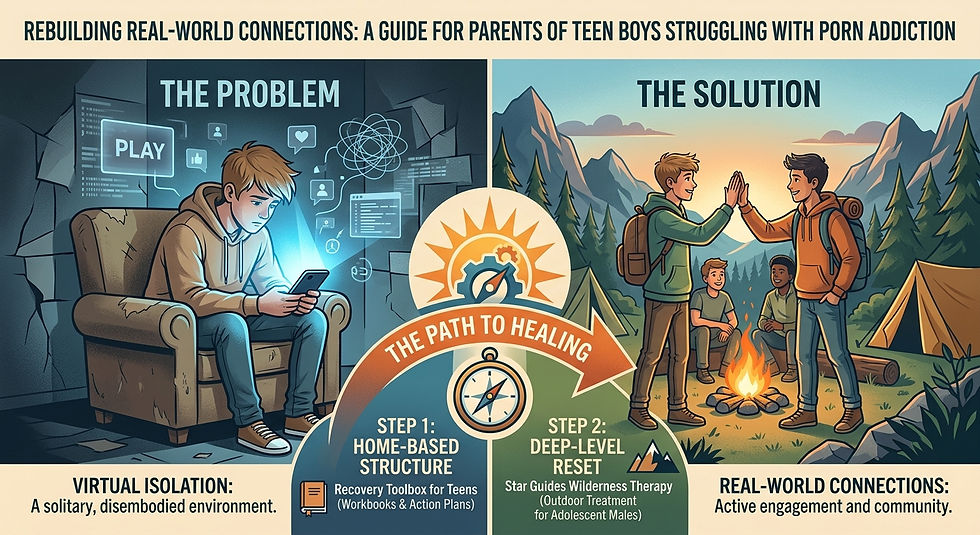
Seeking Professional Support: If the habit is deeply ingrained, consider Cognitive Behavioral Therapy (CBT). A specialist can help identify underlying triggers like social anxiety or academic pressure. For practical tools, check out the Recovery Toolbox for Teens at TherapyAssociates.net. The bookstore includes the Breaking Free Workbook, The Parent Guide, and 101 Tips for Quitting Porn.



Comments