


Beyond the Screen: Understanding Your Son’s Struggle with Pornography (and How to Help Him Heal)

If you have discovered that your teenage son is struggling with pornography, your initial reaction was likely a mix of heartbreak, fear, anger, and confusion. Many parents instinctively assume the problem boils down to raw teenage hormones, curiosity, or an unrestrained desire for sexual stimulation.
However, modern clinical research reveals a far more complex truth: Pornography is rarely about sex; it is a counterfeit fix for a deep-seated desire for human intimacy, emotional connection, and coping.
To effectively help your son, you must first look past the surface behavior and understand what is driving it.
The Illusory Cure: Why Teen Boys Fall into the Trap
During adolescence, a young man's brain undergoes massive structural changes. He is tasked with navigating social anxiety, academic pressures, changing family dynamics, identity creation, and intense emotional peaks. Crucially, the brain's emotional center (the limbic system) matures much faster than its rational control center (the prefrontal cortex).
When a young man experiences emotional pain—whether it is loneliness, stress, rejection, low self-esteem, or trauma—his brain seeks rapid relief. Highly explicit, digital pornography offers a high-potency dopamine surge that instantly numbs discomfort.
In her foundational research on adolescent pornography consumption, Dr. Jill Manning noted that youth rarely use explicit media solely for physical gratification; instead, it frequently serves as an unregulated coping mechanism for stress, loneliness, and depression. Furthermore, attachment theory highlights that human beings are hardwired for genuine connection. Pornography tricks the adolescent brain by mimicking authentic intimacy, physical presence, and acceptance, without any of the vulnerability, fear of rejection, or emotional risk that real relationships demand.
It sells a dangerous lie: You can have intimacy without vulnerability. Over time, this counterfeit connection reshapes the brain’s reward pathways, trapping young men in a cycle of shame, isolation, and compulsion.

A Case Scenario: Alex’s Story
Consider 16-year-old Alex (a composite scenario based on common clinical presentations).
To his parents and teachers, Alex seemed like a typical high school sophomore. He was quiet, got decent grades, and participated in track. What his parents didn’t see was his mounting, unspoken distress: Alex felt socially isolated at school, overwhelmed by the pressure to perform academically, and deeply anxious about fitting in.
Late one night, while feeling particularly rejected after a bad day at school, Alex turned to his phone. A quick search provided immediate escapement. For twenty minutes, his anxiety vanished, replaced by an intense dopamine high. He felt temporary comfort and acceptance.
However, within minutes of closing the browser, intense shame set in. Alex promised himself he would never do it again. But the next time he faced overwhelming stress or felt invisible at school, his brain remembered the quickest escape hatch it knew.
Within a year, Alex was trapped in a daily compulsion. He pulled away from family dinners, lost interest in track, slept poorly, and grew increasingly irritable. His parents thought he was just being a "moody teenager," unaware that Alex was caught in a cycle of emotional pain, digital escape, and suffocating guilt.
Alex wasn’t seeking hyper-sexuality; he was a lonely, overwhelmed boy starving for real connection and healthy emotional relief.
Evidence-Based Pathways to Freedom
Overcoming compulsive pornography use requires more than just willpower or parental restriction—it demands replacing the counterfeit escape with genuine healing, dynamic skill-building, and structural support. Two primary, evidence-based tools offer a clear path forward:
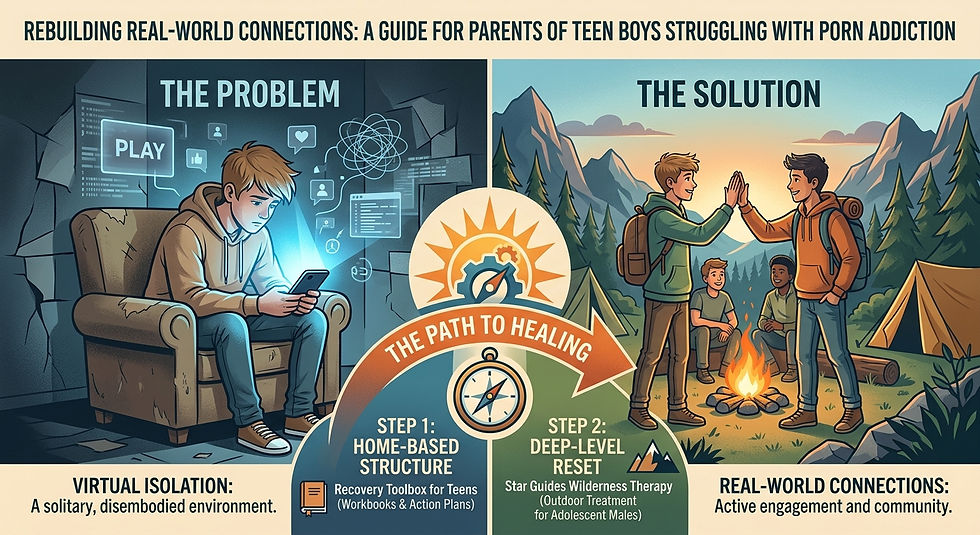
1. The Recovery Toolbox for Teens
The Recovery Toolbox for Teens is a specialized, multi-component therapeutic intervention designed specifically for youth dealing with problematic sexual behaviors and digital compulsions. Rather than relying on simple shame-based lectures, this clinical framework utilizes Cognitive Behavioral Therapy (CBT) and Dialectical Behavior Therapy (DBT) principles to help teens:
Identify the Core "Why": Helps teens map out their specific emotional triggers (e.g., boredom, anxiety, loneliness) rather than just treating the symptom.
Develop Actionable Coping Tools: Equips teens with concrete, practical strategies to regulate stress and manage emotional distress in healthy ways.
Engage the Family: Includes dedicated components for parents to foster an atmosphere of transparency, healthy boundaries, and open communication without resorting to shaming.
2. STAR Guides Wilderness Therapy
For teens trapped in deep, severe patterns of compulsion where home-based boundaries are no longer sufficient, STAR Guides Wilderness Therapy provides a specialized intervention. Located in Utah, STAR Guides is a licensed outdoor behavioral healthcare program specifically dedicated to adolescent males struggling with compulsive sexual behaviors, pornography dependence, and related attachment trauma.
Complete Digital Disruption: By placing the teen in a technology-free, wilderness setting, STAR Guides completely disrupts the addictive feedback loop, allowing the young man's brain and nervous system to reset.
Clinical Depth: Led by licensed therapists specializing in adolescent sexual behavior and trauma, the program uncovers the underlying emotional struggles driving the behavior.
Building Authentic Self-Worth: Through outdoor challenges, peer group support, and experiential mentoring, teens rediscover their genuine strengths, develop real resilience, and learn what true connection and accountability feel like.
A Message of Hope for Parents
If your son is struggling, remember that his behavior is an SOS, not a permanent reflection of his character or future. When you shift your perspective from seeing a "rebellious teen" to a "struggling young man using a bad tool to solve a real emotional problem," the pathway to healing changes from anger to compassionate intervention.
With the right balance of love, clear boundaries, and evidence-based interventions, your son can break free from the counterfeit, rebuild his emotional resilience, and discover true, lasting intimacy.


Comments