


Beyond the Screen: Why Your Teen Son’s Porn Habit is an Emotional Processing Problem—And How to Fix It

If you are a parent watching your teenage son struggle with a pornography habit, you’ve probably spent sleepless nights wondering why.
Why is he choosing a screen over real life? Why does he seem so distant, so angry, or completely shut down?
It is easy to assume the core issue is just a high sex drive, a lack of moral willpower, or the inescapable grip of high-speed internet. But as a psychotherapist who has spent years in the trenches with these boys, I am here to tell you that what looks like a sexual problem is almost always an emotional processing problem.
There is a direct, deeply entrenched connection between pornography addiction in teen boys and their inability to express—or even identify—their own emotions. When a teen boy cannot speak his pain, he numbs it. And today, the most accessible, high-potency numbing agent in the world is sitting right in his pocket.
To break this script, we have to help him build a specific, vital asset: his emotional expression muscle. ---
The Core Problem: Stagnated Emotional Development
As boys enter adolescence, society often hands them a very rigid, unhealthy script about masculinity. They are told to "man up," hide vulnerability, and suppress fear, sadness, or anxiety. But those emotions don't just disappear. They look for an exit ramp.
In adolescent addiction research, we consistently see a phenomenon called alexithymia—the clinical term for the inability to identify and describe emotions in oneself.
When a teen boy lacks the vocabulary to say, "I feel rejected," "I feel invisible," or "I am terrified of failing," his nervous system goes into overdrive. He experiences hyperarousal or deep dysphoria, and his brain desperately craves chemical relief.
Pornography acts as an immediate, artificial neurological pacifier. It floods the brain with dopamine, temporarily wiping out underlying anxiety or loneliness.
Here is the tragedy: because he uses pornography to bypass his feelings, his natural emotional expression muscles remain completely under-developed. His emotional growth literally stagnates at the age the addiction took hold.
Therefore, emotional rehabilitation is the absolute cornerstone of recovery. We cannot just stop the behavior; we have to heal the emotional stuntedness driving it. Here are three steps to do exactly that.
Step 1: Move from Interrogation to Conversation
When parents discover a porn issue, the natural, fear-based reaction is to interrogate: "Are you watching it? How often? Why would you do that?" This immediate interrogation triggers deep shame, and shame causes a teen boy to slam the emotional vault shut. He will lie, minimize, and isolate further. Instead, we need to shift the narrative entirely.
The "Stunt Performance" Analogy
Don't just ask him if he's watching porn. Talk to him about the profound difference between a digital screen and a human soul. Explain that pornography is essentially a "stunt performance."
When you watch an action movie, you know the actor didn't actually jump out of an exploding building; it’s a choreographed, manufactured stunt. Pornography is exactly the same—it is a manufactured stunt performance of intimacy. It strips away the human soul, vulnerability, and actual relationship, leaving a hollow caricature.
By framing it this way, you take the target off him as a "bad kid" and place the focus on the deception of the medium.
Step 2: Model Emotional Awareness
If a teenage boy cannot identify his own emotions, he will never be able to navigate them safely. We have to help him label his feelings, but he isn't going to volunteer this information unprompted. You have to model it first.
Show him what healthy emotional expression looks like in your own life by vocalizing your internal world:
"I had a really frustrating day at work today. I felt incredibly unappreciated, and it made me feel anxious. I noticed I wanted to just zone out on my phone, but I realized I just needed to talk about it."
When you notice him getting angry or shutting down, don't meet his anger with anger. Help him untangle the knot:
"Hey, I see you slamming the door. I know you're angry, but underneath that anger, are you feeling stressed about school? Are you feeling overwhelmed?"
By giving him the words, you are literally acting as his emotional prosthetic until his own muscles grow. You show him that emotions are not dangerous, they are not unmanly, and they can be spoken instead of medicated with a screen.

Step 3: Exercise the Emotional Expression Muscle Daily
Understanding emotional awareness in theory is a great start, but it means nothing without consistent, daily action.
Think of it like physical fitness. If your son wants to build his biceps, he can't just read a book about weightlifting—he has to actually pick up the weights and do the repetitions. Rebuilding stagnated emotional development works exactly the same way. He has to exercise his emotional expression muscles every single day.
This practice can happen through journaling, short daily check-ins with you, or in therapy. A highly effective framework to teach your teen is the "I feel..." messaging model. This is a simple, two-part exercise where he identifies specific emotions and describes why he feels that way.
The Old, Stagnant Script (Grunting / Numbing) | The New Script (Exercising the Muscle) |
"I'm fine." / "I'm just pissed." | "I feel anxious and overwhelmed because I have three tests tomorrow and I don't feel prepared." |
Shuts door, isolates with a screen. | "I feel rejected because my friends didn't invite me to sit with them at lunch today." |
To a teen boy whose emotional growth has been stunted, this is heavy lifting. In the beginning, it will feel clunky and uncomfortable. He might resist it.
But by forcing his brain to connect a physiological sensation to an actual emotion and vocalize the root cause, he is actively rewiring his brain. He learns that he doesn't need to run to a screen to escape a feeling when he has the power to name it, face it, and speak it.
Building Your Recovery Toolbox
If you are feeling overwhelmed right now, please know that a simple "talk" isn't always going to cut it. The pull of the digital world is incredibly strong, and software filters are easily bypassed by a tech-savvy teen.
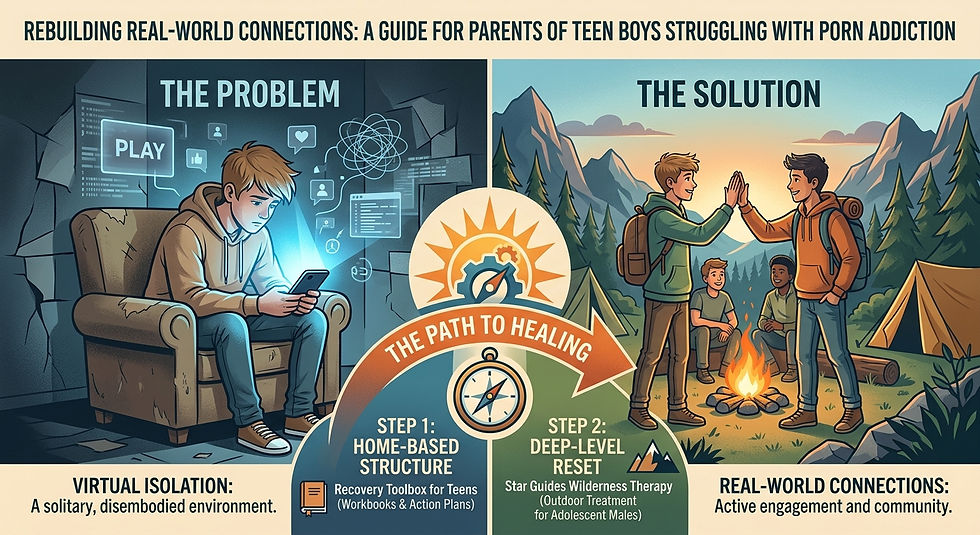
True recovery requires an evidence-based, highly structured program designed to heal the family system and replace a toxic, hidden script with one of radical honesty. If you need a structured plan, we highly recommend utilizing the Recovery Toolbox for Teens, which includes:
The Breaking Free Workbook: Designed specifically for your teen to work through root causes.
101 Tips for Quitting Porn: Practical, daily actionable steps for your teen boy.
The Parent Guide: Your personal manual to navigate boundaries, conversations, and emotional modeling.
You can locate these resources directly through the bookstore at therapyassociates.net.
When More Intensive Care is Needed
For some families, the addiction has progressed past the point of early home intervention. If your teen is acting out compulsively, completely decompensating academically or socially, or dealing with severe co-occurring mental health issues, an outpatient workbook may not be enough to break the cycle.
In those serious, complex cases, specialized, immersive care is often the safest path forward. Programs like Star Guides Wilderness Therapy—a premier outdoor behavioral healthcare program specifically designed for adolescents struggling with compulsive sexual behaviors and digital addictions—remove teens from digital noise and intensely target emotional stagnation in a therapeutic environment.
Whether it’s starting with workbooks at home or seeking residential therapy, the vital thing is that you do not stay paralyzed. Breaking the script starts with you. There is a path to healing for your son, and you have the power to help him find it.
For weekly guidance and resources to support your family's journey, subscribe to our updates and visit therapyassociates.net.



Comments