


Navigation Guide for Parents: The Hidden Hazards of "Edging" and Modern Pornography

As a parent of a teenage boy, you likely know that the digital world your son navigates is vastly different from the one you grew up in. If your teen is actively striving to overcome a pornography addiction, you might think that putting blocks on explicit websites is enough.
However, the landscape of digital dependency has shifted. Today, the danger often isn't a hidden website—it’s hidden in plain sight on his social media feed through a highly risky practice known as "edging," fueled by a sophisticated algorithm.
Redefining Pornography for the Digital Age
To help your son, we first need to update our definition of what pornography actually is. If we only define pornography as explicit nudity or hardcore acts, we miss the daily reality of a teen boy's struggle.
The Modern Definition: For a teenager striving for recovery, pornography is any medium used specifically to seek sexual stimulation, rather than just full nudity or explicit acts.
This means a TikTok dance, a fitness influencer's reel, an Instagram bikini post, or even heavily stylized video game characters can function exactly like pornography if your son is using them to get a neurochemical "high."
In fact, science backs this up. A landmark 2020 study by researcher Lei Han and colleagues looked at how the brain processes sexual stimuli. The study indicated that revealing or partially clothed images can actually be more sexually stimulating and create higher levels of psychological arousal than full nudity. The anticipation and what is left to the imagination can trigger a massive spike in dopamine, making "soft-core" digital media incredibly potent.

The Danger of "Edging"
This brings us to a practice that is derailed many teens' recovery efforts: edging.
Edging is the practice of intentionally stimulating oneself sexually—often while viewing these partially clothed or provocative images—and stopping just before reaching orgasm.
Teens often rationalize this behavior, thinking, "I didn't view actual nudity, and I didn't go all the way, so I didn't relapse."
This is a dangerous misconception. Edging keeps the brain flooded with dopamine for extended periods—sometimes hours. Instead of a quick spike and drop, the brain is marinated in addictive neurochemicals. This not only strengthens the addiction pathways in a developing teenage brain, but it also makes an eventual full relapse almost inevitable. Edging isn't avoiding a relapse; it is actively prolonging the addiction cycle.
The Algorithm: When Pornography Finds Your Teen
One of the most frustrating aspects for parents and teens alike is that pornography now finds the teen, rather than the teen having to hunt for it.
Social media algorithms (like those on TikTok, Instagram, and YouTube Shorts) are designed with one goal: keeping your son's eyes on the screen. They don't just track what he likes or comments on; they track micro-behaviors.
The Hover Effect: If your son pauses, slows his scrolling, or hovers over a provocative thumbnail for even two seconds, the algorithm registers it as high interest.
The Escalation: Within minutes, the algorithm will feed him slightly more provocative stimuli to maintain that attention.
Before he knows it, a harmless scroll turns into a minefield of triggers. For a teen trying to quit, this constant bombardment makes willpower alone an unfair fight.
Disrupting the Cycle: Evidence-Based Interventions
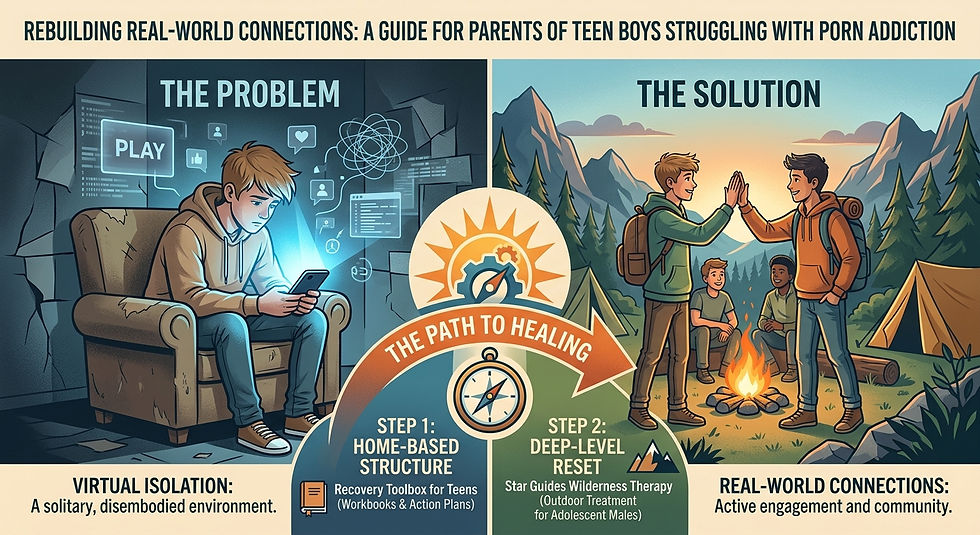
If your son is caught in this loop of edging and algorithmic triggers, traditional talking therapies or simply taking his phone away might not be enough to break the neural patterns. True recovery requires disrupting the addiction process with targeted, evidence-based tools.
Here are two highly effective interventions to consider:
Intervention | How it Helps | Best Suited For |
A structured, practical set of cognitive-behavioral tools designed specifically for adolescents to identify triggers, halt the edging cycle, and rebuild healthy habits. | Teens needing daily structure, boundary-setting tools, and actionable coping mechanisms at home. | |
An outdoor behavioral healthcare program that removes the digital noise entirely. By replacing screens with nature and intensive therapy, it resets the brain's dopamine reward system. | Teens struggling with deep-seated addiction where outpatient care hasn't broken the cycle of relapse. |
Moving Forward
Overcoming a pornography addiction in the modern era requires understanding the subtle traps like edging and algorithmic loops. Validate your son's struggle—it is harder to be continent today than it ever has been before. But with the right definition of the problem and the right tools in your arsenal, recovery is entirely possible.
What specific changes have you noticed in your son's screen habits that make you suspect the algorithm might be driving his struggles?



Comments