


The Battle for His Identity: How Teen Pornography Addiction Derails Psychosocial Development (and How to Fight Back)

As parents, we watch our teenage sons navigate a chaotic world, hoping they will emerge as confident, independent young men. But behind closed doors, a silent epidemic is disrupting this vital transition. If your teen son is struggling with compulsive pornography use, it is easy to view it simply as a behavioral phase or a moral failing.
Developmental psychology, however, reveals a much deeper, more alarming truth.
When a teenage boy develops a pornography addiction, it does not just hijack his brain’s reward system—it directly halts his psychological growth. By viewing this crisis through the lens of Erik Erikson’s Stages of Psychosocial Development, we can clearly understand the profound risks of leaving this addiction untreated, and explore the specialized interventions that can bring your son back.
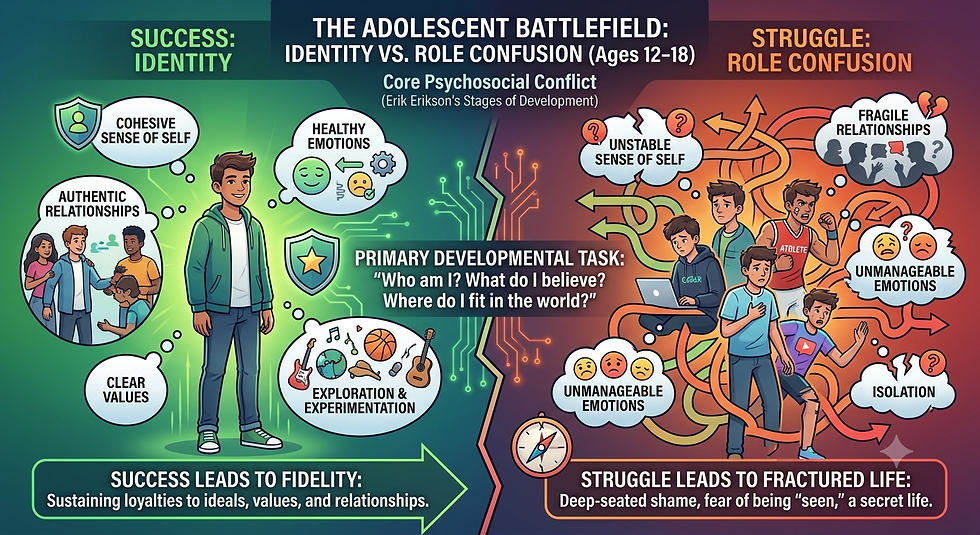
The Adolescent Battlefield: Identity vs. Role Confusion
Erik Erikson, a pioneering developmental psychologist, established that adolescence (roughly ages 12 to 18) is defined by a core psychosocial conflict: Identity vs. Role Confusion.
During these years, a boy’s primary developmental task is to answer the fundamental questions: “Who am I? What do I believe? Where do I fit in the world?” To navigate this stage successfully, a teen must experiment with social roles, build authentic relationships, learn to manage uncomfortable emotions, and consolidate a cohesive sense of self.
Success in this stage leads to the virtue of fidelity—the ability to sustain loyalties to ideals, values, and relationships despite inevitable contradictions.
But when pornography enters the equation, this healthy developmental process is completely derailed.
How Pornography Distorts the Search for Identity
An untreated pornography addiction fundamentally sabotages a teen boy's attempt to establish a authentic identity, steering him directly into profound Role Confusion. This happens across three critical domains:
1. The Creation of a Fractured Self (The Secret Life)
To build a healthy identity, a teen needs an integrated life where his internal values match his external behavior. A pornography addiction forces a boy to live a double life. He presents a compliant, standard identity to his parents, teachers, and peers, while harboring a secret, shame-fueled identity in the digital world. This fracturing prevents him from knowing who he truly is, anchoring him in a state of perpetual role confusion.
2. Weaponized Intimacy and Distorted Sexuality
Healthy adolescent identity involves learning how to navigate the complex, often awkward world of real-world relationships and sexual maturity. Pornography provides a hyper-stimulating, consequence-free illusion of intimacy. It teaches the adolescent brain that relationships are transactional, objects are for consumption, and vulnerability is unnecessary.
Instead of forming an identity based on genuine connection, his sexual identity becomes fused with highly pixelated, extreme, and unrealistic scenarios.
3. The Dopamine Hijack of Emotional Coping
Adolescence is supposed to be full of friction. Overcoming social anxiety, academic stress, and loneliness is exactly how teens figure out what they are made of. Pornography acts as an emotional escape hatch. Whenever an untreated teen faces distress, he numbs out with a screen. Because he never faces the normal growing pains of life, his emotional identity remains stunted. He enters young adulthood without the psychological coping mechanisms required to survive.
The Long-Term Consequences of Untreated Addiction
If a boy exits his teenage years trapped in Role Confusion, the developmental deficit cascades into Erikson’s next stage: Intimacy vs. Isolation (Young Adulthood).
The long-term consequences of an untreated teen pornography addiction include:
Severe Social Isolation: An inability to form deep, authentic romantic or platonic relationships due to deep-seated shame and fear of being truly "seen."
Sexual Dysfunction: Increasing rates of induced erectile dysfunction and arousal issues in real-world contexts because the brain has been conditioned to respond only to extreme digital stimuli.
Apathy and "Failure to Launch": Chronic dopamine depletion dulls motivation for real-life achievements, such as higher education, career pursuits, or hobbies.
Entrenched Mental Health Struggles: Prolonged battles with low self-esteem, chronic anxiety, and treatment-resistant depression.
The Roadmap to Recovery: Specialized Interventions
As a parent, realizing the depth of this crisis can feel overwhelming. Standard talk therapy or basic parental controls on internet routers are rarely enough to untangle a compulsive behavioral loop that has fused with a boy's developing identity.
True recovery requires intensive, specialized intervention designed specifically for the adolescent mind. Two of the most effective, targeted resources available today include:
1. Recovery Toolbox for Teens
Recovery cannot happen in a vacuum of willpower alone; your son needs an actionable, structured framework to rebuild his life. Recovery Toolbox for Teens is a clinical curriculum specifically designed to address problematic sexual behavior and digital addictions in adolescents.
Rather than focusing entirely on the negative behavior (the pornography), this intervention equips teens with a practical "toolbox" for daily life. It utilizes Cognitive Behavioral Therapy (CBT) and Acceptance and Commitment Therapy (ACT) concepts to help teens:
Identify their unique emotional triggers (loneliness, boredom, stress).
Deconstruct the cognitive distortions and rationalizations that lead to relapse.
Build emotional regulation strategies so they no longer rely on digital numbing.
Cultivate accountability protocols that restore transparency between the teen and his family.
By teaching your son how to handle his internal world, the Recovery Toolbox helps him replace a fragmented online habits with an identity rooted in real-world competence.
2. Star Guides Wilderness Therapy
Sometimes, the digital gravity is simply too strong. When a teen boy is completely consumed by his addiction, his brain is in a state of constant neurological inflammation from continuous dopamine spikes. In these severe cases, an environment change is necessary to break the cycle.
Star Guides Wilderness Therapy is a premier outdoor behavioral healthcare program specifically tailored for adolescents struggling with compulsive internet and pornography use, as well as sexual behavior disruptions.
By placing your son in a pristine, distraction-free wilderness environment, Star Guides facilitates a profound intervention:
The Digital Detox: Stripping away all screens allows his hijacked neural pathways to naturally reset, lowering his baseline anxiety and clearing the mental fog.
Experiential Identity Building: In the wilderness, a teen cannot hide behind an avatar or a secret search history. He must face immediate, natural challenges (setting up camp, hiking, weather changes). Overcoming these obstacles builds a genuine, unshakeable sense of self-worth.
Intensive Specialized Therapy: Star Guides utilizes highly specialized clinicians who understand the intersection of trauma, neurobiology, and sexual compulsivity in adolescents. Group therapy sessions with peers facing the exact same struggles help dissolve the toxic shame that feeds the addiction.
A Message of Hope for Parents
If your son is caught in this web, do not lose heart. The very definition of Erikson's identity stage means that your teen's psychological framework is still incredibly fluid. His brain is highly adaptable, and his story is far from written.
By stepping in with targeted, specialized interventions like the Recovery Toolbox for Teens and Star Guides Wilderness Therapy, you are not just stopping a harmful behavior. You are disrupting his role confusion, pulling him out of the shadows of a digital world, and giving him the tools and environment he needs to forge a healthy, resilient, and authentic identity.


Comments