


The New Landscape of Teen Porn Addiction: Navigating the Surge of AI and How to Protect Your Son

If you are a parent watching your teenage son struggle with a pornography addiction, you already know the heavy emotional toll it takes on a family. You’ve likely experienced the cycle of discovery, remorse, device lockdowns, and shattered trust.
But if you feel like the ground beneath you is shifting, you aren’t imagining it. The pornography landscape has fundamentally changed. The rise of generative Artificial Intelligence (AI) has turned a standard internet addiction into a hyper-personalized, deeply gripping neurological trap.
To help your son break free, you first need to understand the exact mechanics of what his brain is fighting. Here are the three current AI porn trends quietly impacting teen boys, what the science says, and how you can intervene with evidence-based support.
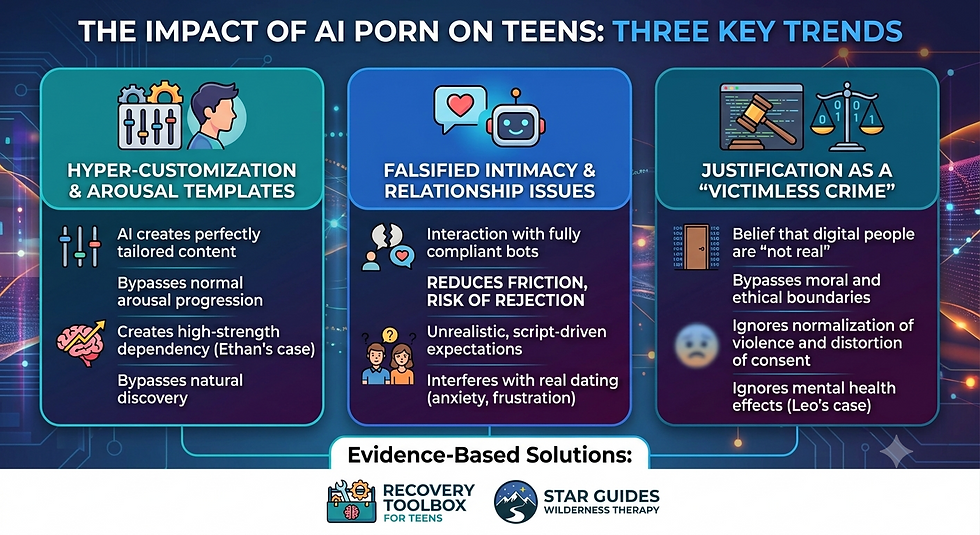
1. Hyper-Customization: The Ultimate Arousal Template
Traditionally, users were consumers of whatever content was already available online. AI has turned viewers into creators. Through AI nudification apps, deepfake generators, and prompt-based video tools, teens can now customize every variable of their consumption. They can dictate the exact physical features of an actress, the precise scenario, the dialogue, and the progression of the video.
The Neurological Trap
In addiction science, a sexual arousal template is the specific cluster of behaviors, traits, and contexts that trigger a person's sexual desire. When a teen can manipulate an AI tool to perfectly match his emerging fantasies, he bypasses the natural process of discovery. The brain is hit with unprecedented levels of dopamine because the content is mathematically optimized to satisfy his specific, highly concentrated preferences.
Case Scenario: Ethan (Age 15) Ethan started using standard internet pornography at age 13. Over time, tolerance set in, and he required more extreme or novel scenarios to achieve the same dopamine rush. When he discovered generative AI tools, he began creating custom images and scripts tailored exactly to his specific, niche preferences. Within months, standard internet pornography could no longer trigger arousal; his brain had become conditioned exclusively to the hyper-specific, AI-generated templates he created.
2. The Falsification of Intimacy and the Real-World Fallout
Generative AI doesn't just create images; it creates interactive, conversational bots that pair explicit imagery with simulated emotional intimacy. A teen boy can spend hours "chatting" with an AI entity that never rejects him, never has a bad day, and exists entirely to validate his desires.
The Neurological Trap
Neuroimaging and behavioral research show that the adolescent brain is highly plastic, meaning it wires itself based on repeated experiences. By interacting with perfectly compliant, artificially generated partners, boys develop a profoundly warped conceptualization of sex and relationships.
Real human relationships require vulnerability, navigation of conflict, compromises, and accepting the flaws of a partner. AI eliminates all friction. When these boys attempt to transition to real-life dating, they are met with intense frustration, anxiety, and erectile dysfunction. Real girls do not look like airbrushed algorithms, nor do they act like programmed scripts. The artificially created arousal template directly interferes with their ability to form genuine, reciprocal human bonds.
3. The "Victimless" Justification
One of the most insidious aspects of AI pornography is how easily teenagers justify its use. When confronted, many boys will argue, "Why does it matter? It's just lines of code. No real women were harmed, and no one was trafficked to make this. It's a victimless crime."
The Neurological Trap
This defense mechanisms allows a teen to completely bypass the moral and ethical boundaries that might otherwise slow down an addiction. They separate the digital entity from human reality.
However, current data tells a very dangerous story about how this impacts the user. 2026 data from the Internet Watch Foundation (IWF) highlights a massive, unprecedented surge in extreme, photo-realistic AI-generated material online. Analysts warn that the easy availability of highly realistic AI pornography significantly normalizes sexual violence, alters healthy sexual scripts, and deeply distorts the user's perception of consent.
Even if the pixels on the screen aren't a real person, the neurochemical reaction in your son's brain is entirely real. His brain cannot tell the difference between a synthetic dopamine hit and a real one—the neural pathways of dependency are carved exactly the same way.
Case Scenario: Leo (Age 16) When Leo’s parents discovered hidden files of explicit AI images on his laptop, Leo was defensive but calm. He firmly believed he hadn't done anything wrong because the people in the images were entirely synthetic. He didn't see that his daily isolation, his plummeting grades, and his intense social anxiety around girls at school were the direct legal and emotional "victims" of his addiction.
Moving Toward Real Healing: Evidence-Based Interventions
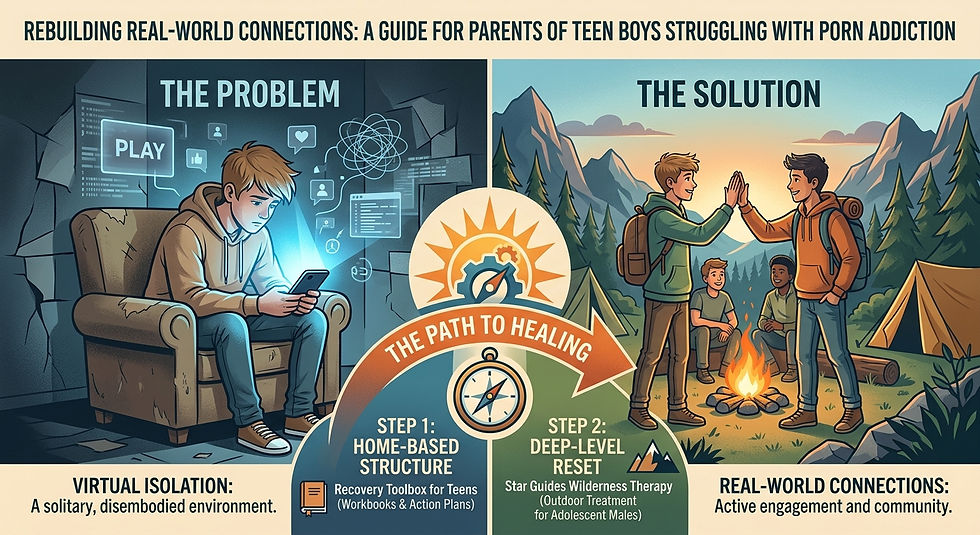
If your son is trapped in this cycle, standard screen-time limits or home filtering software are rarely enough. A hyper-personalized digital addiction requires a comprehensive, specialized psychological response.
Two of the most effective, evidence-based interventions specifically designed for adolescent males struggling with compulsive sexual and technology behaviors include:
The Recovery Toolbox for Teens
True recovery requires structured, daily internal work. The Recovery Toolbox for Teens is a specialized, comprehensive curriculum designed to help young men build emotional regulation, identify core behavioral triggers, and systematically rebuild broken family boundaries.
The Breaking Free Workbook: Utilizes clinical screening tools (like the YPAST) to help teens honestly evaluate the depth of their problematic technology use.
The Parents Workbook: Arms mothers and fathers with the concrete communication strategies needed to support a son through the difficult neurological withdrawal periods without falling back into patterns of shame or suspicion.
STAR Guides Wilderness Therapy
When a teen's neural pathways have been profoundly hijacked by AI customization and digital isolation, a complete environment reset is often necessary to break the cycle. Located in the high desert of Utah, STAR Guides Wilderness Therapy is a premier, Joint Commission-accredited program that focuses specifically on adolescent males (ages 13–17) dealing with compulsive sexual behaviors, pornography addiction, and associated trauma.
The "Unplugged" Advantage: By completely removing access to devices, algorithms, and digital triggers, the adolescent brain is given the critical, multi-week buffer it needs to lower baseline dopamine levels and begin neurological healing.
Experiential and Clinical Integration: Under the strict guidance of licensed, field-based therapists, boys participate in intensive individual and daily group therapy while developing resilience through primitive outdoor skills.
Rewiring for Real Life: STAR Guides focuses heavily on repairing family systems, helping young men transition away from isolated digital fantasies and back toward healthy, authentic, real-world human connections.
The emergence of AI porn means our sons are facing a level of digital temptation that no generation before them has ever had to navigate. They cannot fight a mathematical algorithm alone. By understanding the trends, recognizing the cognitive distortions, and stepping in with targeted, specialized care like STAR Guides and The Recovery Toolbox, you can help your son log off the simulation and reclaim his real life.


Comments