


Unmasking the Double Life: How to Help Your Teen Boy Heal From Pornography Addiction

As a parent, watching your son navigate his teenage years can feel like managing a high-stakes construction project. He is building his identity, brick by brick. To form a healthy, resilient sense of self, a teen needs an integrated life—a state of being where his internal values seamlessly match his external behavior.
When a pornography habit turns into a compulsive loop, that construction project is violently disrupted. Instead of building a unified identity, the addiction forces him to construct a hidden addition. It creates a fractured self.
The Psychology of the Double Life
In developmental psychology, Erik Erikson highlighted the central task of adolescence: Identity vs. Role Confusion. A teen is meant to experiment, make mistakes, and ultimately figure out who he is.
HHowever, compulsive pornography use forces a young man to live a double life, trapping him in perpetual role confusion:
The Persona: He presents a compliant, standard "good guy" identity to you, his teachers, and his peers. He smiles, completes his homework, and plays sports.
The Shadow: Behind closed doors, he harbors a secret, shame-fueled identity rooted in the digital world.
This fracturing prevents him from knowing who he truly is. He stops developing organically and becomes an actor playing a role, losing touch with his genuine self before he even has the chance to fully form it. However, compulsive pornography use forces a young man to live a double life, trapping him in perpetual role confusion:
The Persona: He presents a compliant, standard "good guy" identity to you, his teachers, and his peers. He smiles, completes his homework, and plays sports.
The Shadow: Behind closed doors, he harbors a secret, shame-fueled identity rooted in the digital world.
This fracturing prevents him from knowing who he truly is. He stops developing organically and becomes an actor playing a role, losing touch with his genuine self before he even has the chance to fully form it.

What the Research Tells Us About the Teen Brain
Understanding the neurobiology of the adolescent brain removes the mystery—and much of the personal stigma—surrounding this struggle.
The Prefrontal Cortex Gap: The prefrontal cortex—the area of the brain responsible for impulse control, long-term decision-making, and emotional regulation—is not fully mature until a person reaches their mid-twenties. Meanwhile, the limbic system (the brain's reward center) operates at full throttle during puberty.
The Neuroplasticity Double-Edged Sword: Research in adolescent neurobiology emphasizes that a teenager's brain is in a state of rapid synaptic pruning and high neuroplasticity. High-speed digital pornography delivers artificial, supernormal spikes of dopamine. Because his brain is so malleable, repeated exposure quickly carves deep neural pathways, turning curiosity into a chemical compulsion far faster than it would in an adult.
Relational Detachment: Studies on adolescent media exposure show that frequent porn consumption directly correlates with higher social anxiety, emotional withdrawal from primary caregivers, and skewed perceptions of real-world intimacy.
               [ High Limbic / Reward Drive ]
                             │
       High Dopamine Exposure (Digital Pornography)
                             │
                             ▼
  ┌──────────────────────────────────────────────────┐
  │  Malleable Teen Brain Reinforces Reward Loops     │
  └──────────────────────────┬───────────────────────┘
                             │
   Immature Prefrontal Cortex Struggles to Suppress Urges
                             │
                             ▼
                  [ Compulsive Cycle ]
Case Study: "Liam" (Age 16)
Background: Liam was an A-student, varsity soccer player, and active youth group member. To his parents, he seemed to be thriving.
The Fracture: Around age 14, Liam was exposed to explicit content via a group chat. Within two years, late-night viewing on a smartphone evolved into a daily compulsion. The emotional burden was immediate: Liam became hyper-vigilant about his phone, exploded into unprovoked irritability over simple chores, and began pulling away from family dinners.
The Turning Point: His mother noticed subtle shifts—falling grades in his favorite class, bloodshot eyes, and a sudden, sharp defensiveness over digital privacy. Rather than issuing an ultimatum or expressing disgust, his parents opened a conversation grounded in curious empathy rather than anger: "We've noticed you seem stressed and isolated lately, and we want to help carry whatever's feeling heavy.
"The Outcome: With the secret exposed, Liam experienced an immediate drop in anxiety. His family established clear digital boundaries, introduced structured daily recovery tools, and involved a licensed adolescent counselor. Within six months, Liam’s mood stabilized, his connection with his parents was restored, and he began re-engaging in his real life.
Short-Term vs. Long-Term Impacts
Living a double life takes a massive psychological toll. The longer this fracture exists, the deeper the roots grow.
Stage | Impact Area | Psychological Manifestation |
Short-Term (Teen Years) | Nervous System | Hyper-vigilance & Anxiety: Constant fear of getting caught keeps his nervous system in perpetual "fight-or-flight". |
Relational | Emotional Withdrawal: Isolation driven by the fear that true intimacy requires being known. | |
Behavioral | Defensiveness: Internal pressure leaking out as intense privacy protection, mood swings, or anger. | |
Long-Term (Adulthood) | Relational | Intimacy Issues: Difficulty forming authentic romantic bonds; viewing relationships through a lens of performance. |
Coping | Compartmentalization: Splitting life into "clean" and "dirty" boxes carries into career, marriage, and parenting. | |
Identity | Toxic Shame: Growing up believing "I am a mistake" rather than "I made a mistake," driving secondary addictions. |
Disrupting the Pattern: Pathways to Healing
Because the teenage brain is remarkably adaptable, the fracture can be healed—provided you step in before these behavioral patterns solidify into adult identity.
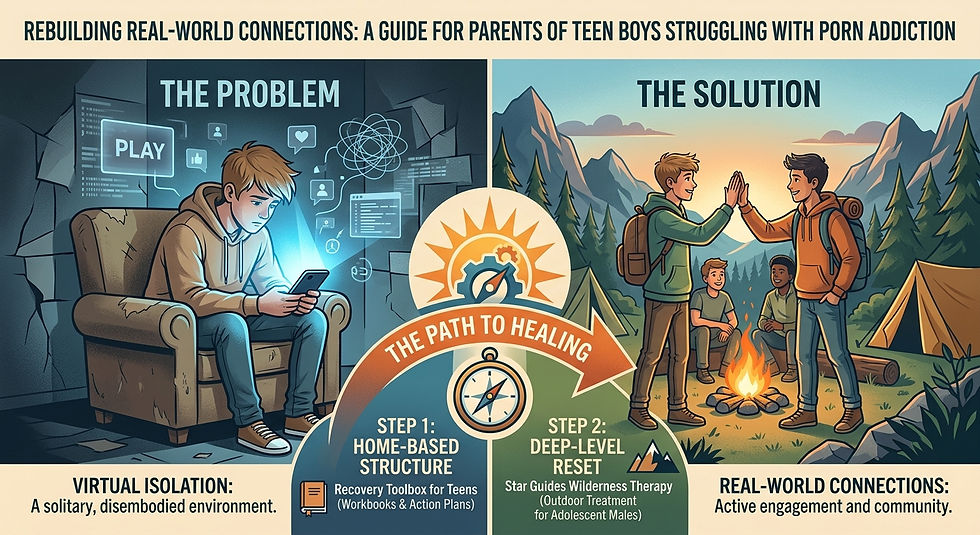
1. The At-Home Intervention (Early to Moderate Struggles)
For teens dealing with early or moderate compulsions, a structured, shame-free home environment is highly effective:
Breaking Free Workbook: Interactive workbook helps teens map out their specific triggers, understand the underlying neuroscience, and take ownership of their own recovery.
The Parent Roadmap: Shift from a prosecutor to a partner. Equip yourself with clear language, firm digital boundaries, and emotional tools to support him without relying on shame or lectures.
Tactical Action Guides (101 Tips for Quitting Porn): Provide concrete, daily strategies—such as habit replacement, phone-free zones, and mindfulness exercises—to resist urges and rewire neural pathways.
2. Specialized Care for High-Risk Situations
When digital habits are deeply entrenched, or the parent-child relationship has broken down, at-home tools may not suffice. In severe cases, a complete environmental reset is required.
Programs like Star Guides Wilderness Therapy specialize in removing young men entirely from the digital ecosystem:
Complete Digital Detox: Removing device access interrupts the immediate dopamine loop, allowing brain chemistry to normalize.
Targeted Clinical Care: Specialized therapeutic care addresses underlying trauma, emotional regulation, and compulsive sexual behavior patterns.
Relational Restoration: Away from daily distractions, wilderness programs offer a space to dismantle secrecy and rebuild parent-child relationships on a foundation of trust.
Moving Forward
Discovering that your son is living a secret life can be devastating, but it is also an opportunity to rebuild. By stepping in with directness, clinical clarity, and calm support, you can help him step out of the shadows and begin building a whole, integrated life.


Comments