


Inside the Teenage Brain: The Surprising Science Behind Pornography Withdrawal (and How to Help Your Son Heal)

If you have recently discovered that your teenage son is struggling with pornography, your world has likely been turned upside down. You might be watching him retreat into his room, pushing you away, and reacting with a level of irritability or laziness that feels entirely out of character.
It is easy to look at this behavior and assume it is a behavioral choice, a lack of willpower, or a moral failing. But as a parent, understanding the science behind what is happening in his head changes everything. It shifts your perspective from anger to empathy.
Let's pull back the curtain on the teenage brain, look at why this habit is so incredibly sticky, and map out exactly what to expect during Phase 1: The Initial Withdrawal.
1. The Dopamine Tidal Wave
To understand how a teen gets trapped, we have to talk about a brain chemical you’ve likely heard of: dopamine.
Think of dopamine as the brain’s internal currency for motivation, reward, and anticipation. In a healthy, everyday teenage brain, small micro-doses of dopamine are released when your son achieves a goal, eats a good meal, laughs with a friend, or finishes a tough workout. These small splashes of dopamine reinforce positive behaviors. They tell the brain, "Hey, that felt good. Let's do that again."
But internet pornography is what neuroscientists call a supernormal stimulus. It offers an infinite variety of novelty, accessibility, and intensity that the physical world simply cannot replicate. Instead of a healthy splash of dopamine, it hits the teenage brain like a massive tidal wave.
Because the brain is an incredibly smart organ, it constantly operates on balance. When this massive flood of dopamine occurs repeatedly, the brain realizes it is being dangerously overstimulated. To protect itself, it activates a biological survival mechanism called downregulation (reducing its own sensitivity).
The Noise-Canceling Headphones Analogy-Downregulation simply means the brain reduces its number of active dopamine receptors. Think of it like your son putting on heavy, premium noise-canceling headphones because the music in his environment is just too loud.
Here is the tragedy for your son: once those chemical headphones are on, the rest of the world becomes whisper-quiet.
This creates a state of dopamine desensitization. Suddenly, everyday activities like schoolwork, playing sports, interacting with family, or hanging out with real-life friends feel incredibly dull, boring, and empty.
When you see your son acting lazy, irritable, or defiant, please understand: he isn't choosing to be a hostage to his room. His brain is physically starved for a baseline level of dopamine that only the addiction can temporarily satisfy. He is chasing a chemical equilibrium just to feel normal.
2. The Molecular Switch: Why Willpower Fails
Parents often ask, "Why can’t he just use his willpower and stop? If he knows it's hurting him, why does he keep doing it?"
The answer lies deep at the molecular level. Neuroscience research, spearheaded by leading experts like Dr. Eric Nestler, has identified a specific transcription factor—a highly stable protein—called $\Delta$FosB (Delta-Fos-B).
Every single time an individual repeatedly exploits the brain's reward pathways through high-dopamine behaviors, $\Delta$FosB builds up and accumulates inside the neurons of the reward center.
Think of $\Delta$FosB as a molecular switch that literally locks addiction-reinforcing neural pathways into place. It acts as a biological memory of the high. Long after your son makes a conscious choice that he wants to stop, this protein remains behind, heightening his sensitivity to triggers, magnifying visual cues, and driving deep, compulsive cravings.
This is why willpower alone fails. True healing isn’t just a matter of your son "changing his mind." It requires waiting for this deep-seated, physical biological marker to naturally degrade and wash out of his system. And that takes time.
3. The Recalibration Timeline: Phase 1
When your son makes the brave choice to stop, his brain enters a massive structural and chemical remodeling phase. Functional Magnetic Resonance Imaging (fMRI) studies, such as those conducted by Dr. Simone Kühn, show us that the brain follows a predictable, chronological sequence of recovery.
For parents, understanding the very first phase of this timeline is critical for survival.

Phase 1: Weeks 2 to 4 – The Initial Withdrawal Phase
This is, without question, the most volatile window of the entire recovery journey. When the sudden drop in artificial dopamine takes hold, those overstimulated neural pathways experience acute withdrawal.
During these first few weeks, your son's brain is crying out for its quick chemical fix. Because his dopamine receptors are still downregulated (those noise-canceling headphones are still firmly on), he is going to feel a profound lack of joy and motivation.
What to expect during these weeks:
Intense, overwhelming cravings
Severe irritability and low frustration tolerance
Anxiety and sudden mood swings
Heavy brain fog and lack of focus
His impulse control will be severely compromised here. As a parent, you must remember: this volatility isn't a sign that recovery is failing. It’s the exact opposite. It’s the sound of the system resetting.
4. Your Phase 1 Action Plan: 4 Strategies
You are not helpless during this volatile phase. Here are four actionable strategies you can implement today to support his neurological resetting process:
1.Provide Structure and Friction: Safety Protocol.
Remember, his prefrontal cortex—the brain's internal brake pedal—is essentially weakened or offline during these early weeks. Do not expect him to rely entirely on internal willpower. Help him by utilizing high-quality internet filters and, crucially, keeping all smartphones, tablets, and computers out of private spaces like bedrooms overnight. Create the external boundaries he cannot physically create for himself yet.
2.Encourage Natural Dopamine Micro-Doses: Brain Retraining.
His brain is starving for reward. Proactively support activities that provide slow, healthy, earned dopamine releases. Encourage weightlifting, team sports, learning a musical instrument, building something physical with his hands, or outdoor adventures. These activities slowly retrain the neural pathways to enjoy the actual process of effort and reward.
3.Normalize the Discomfort: Shame Reduction.
Talk to him openly about the science. Knowledge is power for a struggling teen. Sit down and tell him: "Your brain is going to feel incredibly bored, flat, and irritable for a few weeks. And when that happens, I want you to smile, because that is exactly how we know your brain is successfully healing." Take the mystery and the shame out of withdrawal.
4.Be the Safe Haven: Relational Foundation.
Shame is the absolute fuel of addiction. If your son feels judged, scolded, or cast out when he struggles or expresses discomfort, the pain of that isolation will drive him right back underground to the comfort of the screen. Keep your communication lines open, objective, and deeply rooted in unconditional, unwavering love.
Looking Forward with Hope
The teenage brain is uniquely vulnerable to developing addictions because it is still actively under construction. But that exact same malleability, that exact same youth, means it is also profoundly, beautifully resilient at healing. With time, steady boundary structures, and your consistent, non-judgmental support, his dopamine system will recalibrate. He can and will return to the vibrant, authentic life he deserves.
If pornography use is causing significant distress in your home, please don't walk this road alone. Consider reaching out to a licensed therapist or counselor who specializes in adolescent addiction.
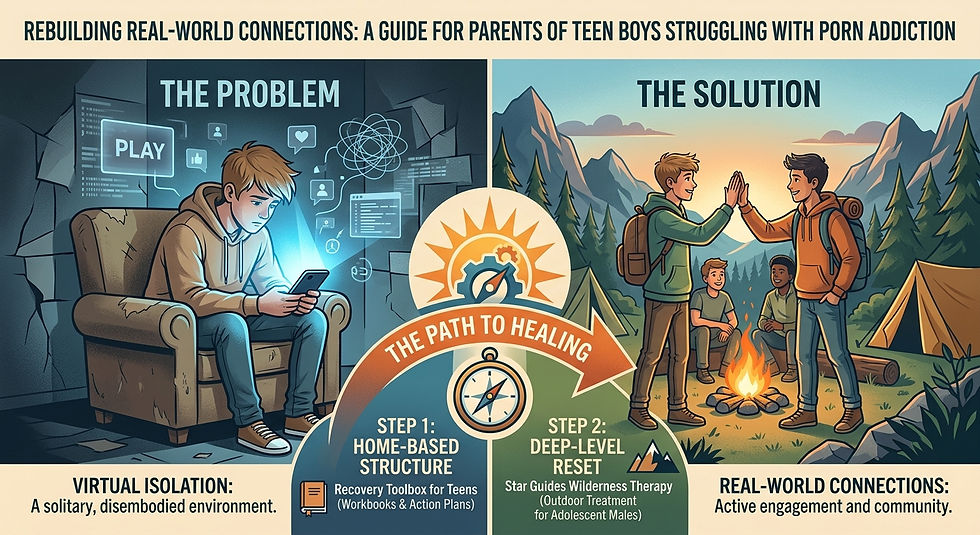
For a comprehensive, step-by-step approach, consider utilizing the Recovery Toolbox for Teens, an evidence-based, structured program designed to guide both you and your adolescent through this exact neurological recovery process.
In acute cases where families encounter serious safety risks, severe mental health crises, high-risk online behaviors, or extreme behavioral issues that cannot be safely managed at home, intensive intervention may be necessary. Programs like Star Guides Wilderness Therapy offer a clinically sophisticated environment designed specifically to stabilize risks, restore emotional regulation, and rebuild healthy family dynamics from the ground up.


Comments