


Navigating Phase 3 of Teen Pornography addiction Recovery: Rebuilding the Brain’s Architecture

Discovering that your teen son is struggling with pornography can feel overwhelming, isolating, and heartbreaking. As a parent, it is completely natural to feel a mix of frustration, fear, and a deep desire to just fix it. If you have been walking this road with him for a few months, you might be wondering when things will truly stabilize.
It helps to think of recovery as a physical healing process. While the initial chemical "reset" happens in the first few months, repairing the deep physical architecture of the brain is a marathon, not a sprint.
Here is what is actually happening beneath the surface during Phase 3: 6 Months to 2+ Years (Long-Term Structural Recovery), and how you can actively support his journey back to a healthy life.
The Science: Rebuilding the Prefrontal Cortex
During the first few months of abstinence, your son's daily dopamine levels begin to balance out. However, Phase 3 is where the heavy lifting happens. This phase is all about structural repair.
Functional MRI (fMRI) studies reveal that compulsive pornography use alters the prefrontal cortex—the front part of the brain responsible for logic, judgment, evaluating consequences, and emotional regulation. When a teen stops using pornography, it can take anywhere from six months to a couple of years for the gray matter and connectivity in this region to fully normalize.
[Healthy Brain Structure]
       ▲
       │  (6 Months to 2+ Years of Disuse)
[Phase 3: Deep Structural Repair]
       ▲
       │  (Stubborn ΔFosB proteins gradually decline)
[Initial Abstinence / Chemical Reset]
A major player in this timeline is a molecular switch called $\Delta$FosB (DeltaFosB). This exceptionally stable protein builds up in the brain’s reward center during compulsive behavior, essentially acting as a "memory trace" of the addiction. It is the reason cravings can suddenly strike out of nowhere, even months into recovery. Over this extended period of Phase 3, these stubborn $\Delta$FosB proteins finally and gradually decline. As they fade, the physical pathways of addiction wither away from disuse, and the healthy, balanced architecture of his brain is restored.
Note on Timelines: The length of Phase 3 depends heavily on how early the habit started and how intense it was. Because a teenager's brain is already undergoing massive development, intervention during this window is incredibly impactful.

Proactive Interventions for Long-Term Success
Because Phase 3 is a long-term neurological remodeling project, willpower alone usually isn't enough. Your son needs structural support to match his structural recovery. Two powerful resources can help guide him through this critical window:
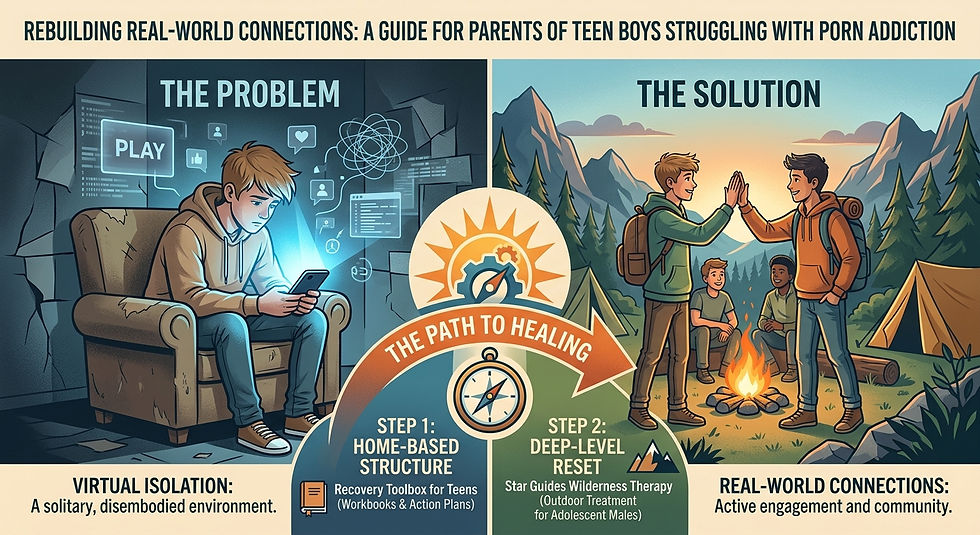
1. Daily Structure: The Recovery Toolbox for Teens Workbooks
Healing requires rewriting daily habits. The Recovery Toolbox for Teens workbooks provide a structured, age-appropriate framework designed specifically for young men. Rather than just focusing on "stopping a behavior," these workbooks focus on starting healthy coping mechanisms. They give your son practical tools to identify his emotional triggers, build emotional regulation skills, and track his progress, making the daily marathon of structural recovery feel manageable.
2. Deep Interventions: Star Guides Wilderness Therapy
Sometimes, the digital environment at home contains too many triggers, or the habit is too deeply entrenched for a workbook alone to move the needle. When long-term structural recovery stalls, Star Guides Wilderness Therapy offers a specialized intervention.
Star Guides combines the healing power of the outdoors with targeted clinical therapy specifically tailored for teens dealing with compulsive digital behaviors and pornography. By removing the digital noise entirely, Star Guides allows your son's prefrontal cortex the clean space it needs to heal, while therapists help him process the underlying emotional challenges that fueled the behavior in the first place.
A Note for Parents
If your son is in this 6-month to 2-year window, remember that slips can happen, but they do not mean the brain architecture he has built up to this point is entirely erased. The goal of Phase 3 is consistency over perfection. By pairing scientific understanding with the right therapeutic tools, you can help him successfully cross the finish line into long-term, lasting freedom.


Comments