


"Starving Inside a Toy Store" Tech Emptiness, and Helping Your Teen Boy Heal From Pornography

If you are a parent sitting in the quiet, heavy realization that your teenage son is struggling with an addiction to pornography, your first reaction is likely a mix of heartbreak, panic, and an overwhelming desire to fix it. You might have tried screen time limits, router blocks, or emotional lectures. Yet, the behavior continues.
It is easy to look at pornography addiction through a left-brained, transactional lens: he sees a trigger, his brain seeks dopamine, he clicks, and the cycle repeats. But if we treat it purely as a mechanical habit, we miss the deeper ache that drives it.
Social scientist and Harvard professor Arthur C. Brooks released an essential framework for this exact modern crisis in his book, The Meaning of Your Life: Finding Purpose in an Age of Emptiness. Brooks' research provides a beautiful, compassionate lens through which we can understand our boys' struggles—and a practical roadmap to help them heal.
He highlights a profound quote by Leo Tolstoy that perfectly captures the modern teenage experience: "Starving inside a toy store."

The Tech Simulation: Why Today's Boys Feel Empty
Your son is growing up in a world that Brooks calls a "tech-laden simulation of ordinary life." He has access to unlimited entertainment, hyper-realistic video games, and social media platforms designed to maximize his attention. By outward appearances, his "toy store" is full.
Yet, Brooks' research shows that while modern youth have plenty of enjoyment and satisfaction (thanks to easy dopamine hits), their core sense of purpose and meaning has collapsed.
When a young man lacks a true sense of meaning, existential emptiness sets in. The human brain cannot tolerate a vacuum of purpose. To escape the anxiety of an unlived life, teenage boys frequently turn to the most powerful, immediate, and accessible escape available: pornography.
Pornography isn't just a pursuit of pleasure; it is a clumsy, desperate attempt to solve a complex existential crisis with a simplistic, digital tool. It is the ultimate simulation of intimacy, love, and conquest—requiring zero risk, zero vulnerability, and zero effort.
Shifting From the Left Brain to the Right Brain
According to Brooks, meaning and love reside primarily in the right hemisphere of the brain, while rules, optimization, and digital abstractions dominate the left. Pornography and tech addictions keep a boy trapped in a hyper-focused, left-brain loop of consumption.
Recovery doesn't happen by simply installing a better internet filter (a left-brain fix). Real recovery happens when we pull them out of the digital simulation long enough to activate the right hemisphere—the place where meaning, mystery, and real connection live.
Brooks outlines specific real-life experiences that break the tech simulation and restore meaning. Here is how you can apply his framework to guide your son toward recovery:
1. Swap Tech for Real-Life Risk
Brooks writes, "If you are afraid of love in real life, it means you need to take more risks with your heart." Pornography is safe; nobody rejects you on a screen. Encourage your son to engage in real, messy, high-stakes environments. Whether it’s joining a sports team, trying out for a play, or asking someone out, he needs to experience the terrifying, beautiful reality of actual human connection.
2. Move from Self-Focus to Love
In his research, Brooks notes a stark truth: "If something makes you focus on yourself instead of others, shun it immediately. It is poison." Pornography is entirely self-centered and consumptive. To counter this, help your son pivot toward contribution. Get him involved in service, volunteering, or helping a neighbor. As Brooks puts it, the ultimate solution to emptiness is love—specifically, "willing the good of the other."
3. Reclaim True Beauty and the Outdoors
Tech simulations overstimulate the eyes but starve the soul. Brooks suggests a simple antidote: "If beauty is missing from your life, go outside in nature immediately. Without your phone." Plan tech-free hiking, camping, or fishing trips with your son. The vastness of nature helps quiet the frantic dopamine pathways and triggers a sense of transcendence.
4. Reframe His Struggle as a Vocation
Instead of letting your son drown in shame, help him reframe his battle. Brooks recommends starting the day by acknowledging that "The trials I face this day are evidence that I am living my life to the fullest." Tell your son that his struggle with pornography is not a definition of his identity; it is a trial that, when overcome, will give him the strength, empathy, and depth to lead others in the future.
Finding Your Ground: Specialized Support for the Journey
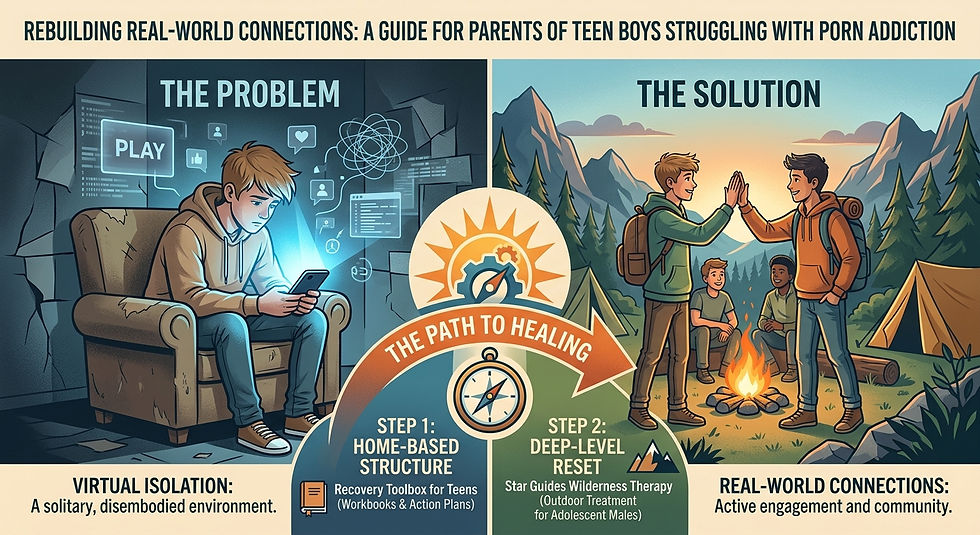
Translating these profound concepts into a daily roadmap can feel daunting for any family, which is why utilizing specialized clinical resources can bridge the gap between theory and actual healing. For structured guidance at home, The Recovery Toolbox for Teens is a comprehensive, evidence-based workbook system specifically designed to help families replace digital compulsion with meaningful habits, featuring tailored tracks to guide both the teenager's accountability and the parent's emotional navigation. However, if your son's struggle has escalated to a crisis point where the home environment can no longer break the left-brain loop, Star Guides Wilderness Therapy provides an intentional, specialized clinical intervention. Based in the rugged high desert of Southern Utah, this program completely unplugs adolescent boys from technology, safely placing them into Brooks' ideal landscape of nature and real-world trial where they can process underlying trauma, unpack compulsive sexual behaviors, and rebuild a genuine, unified identity.
A Note for the Weary Parent
Your son will fail on this road. He will slip up, and so will you. Brooks reminds us that this is completely normal: "Will you fail? Yes, of course—a lot... But you will be pointed in the right direction for progress."
Step away from the role of the digital warden or the disappointed judge. Instead, become his partner in the search for meaning. Stop asking him just about his screen time, and start asking him the big questions that can’t be Googled. Help him step out of the simulated toy store and into a life that actually feels lived.
For a deeper look into how digital shortcuts are eroding our kids' sense of purpose, you might find value in watching The Meaning of Your Life with Arthur C. Brooks, a discussion that delves into his research on reclaiming genuine connection in a tech-saturated world.


Comments