


Behind the Screen: Why Waiting Out Your Teen Son’s Porn Habits Is a Dangerous Gamble

It’s a moment every parent dreads. You glance at your teenage son's phone, or notice his browser history, and your heart drops. Pornography.
In that moment of panic, a dangerous coping mechanism often kicks in for parents: denial. We tell ourselves, "It’s just a phase," "All boys do it," or "He'll grow out of it."
It’s completely understandable to want to look away. Confronting this is uncomfortable, exhausting, and filled with shame. But treating an emerging pornography habit as a normal rite of passage rather than a serious vulnerability is a major mistake. Adolescence is the second most critical window of brain development in a human life. Leaving a compulsive pornography habit untreated doesn't just mean waiting out a phase—it means allowing a deeply addictive script to rewrite your son's future.
Early intervention isn't about shaming him; it's about protecting him from documented, long-term consequences that span every area of his adult life.
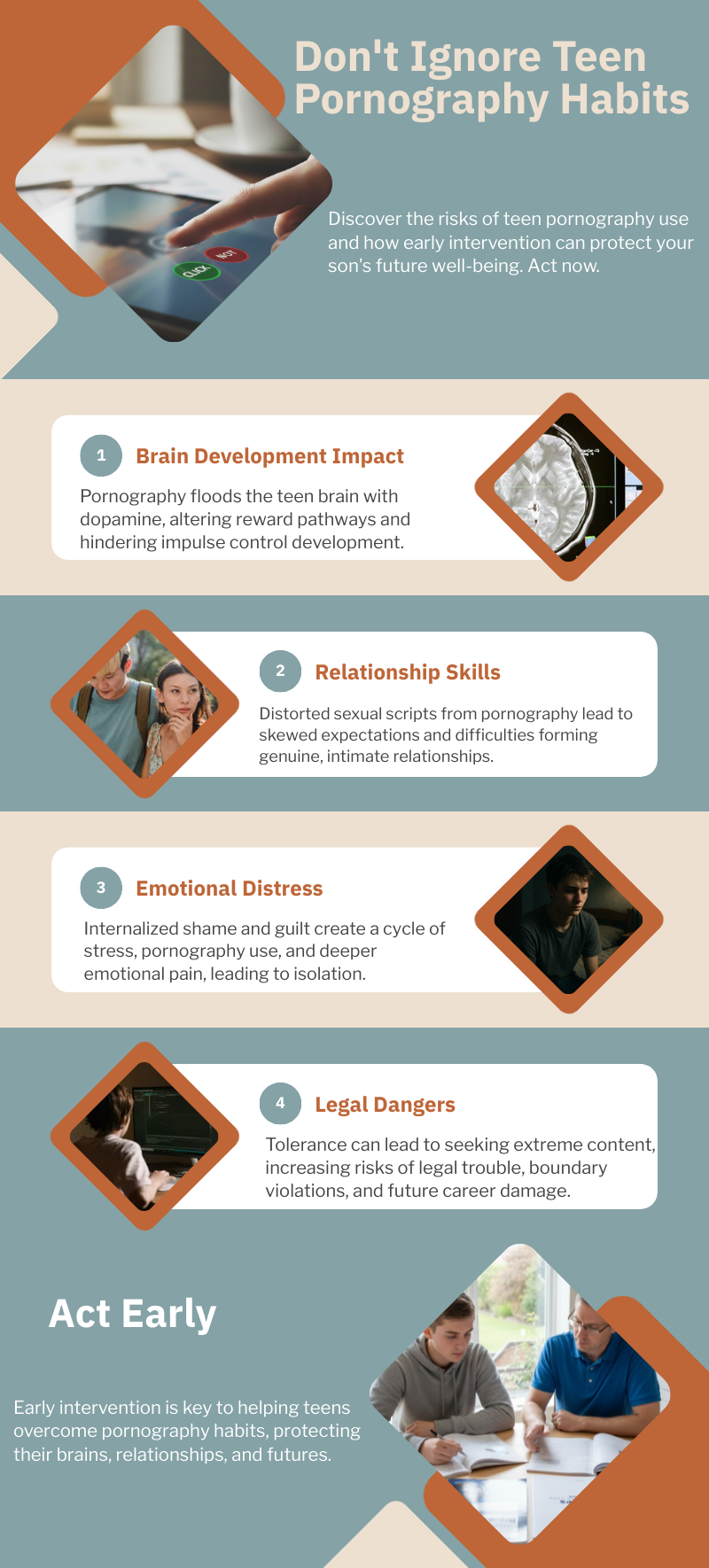
1. The Neurological Impact: Hijacking the Reward Center
The teen brain is highly neuroplastic—meaning it physically molds and builds pathways based on repeated behaviors. When a teen boy repeatedly turns to high-speed internet pornography, he isn't just watching a video; he is flooding his brain with unnatural levels of dopamine.
A landmark study by the University of Cambridge discovered that when individuals with compulsive sexual behavior view pornography, their brain scans show activation in the ventral striatum and amygdala that directly mirrors the brain activity of drug addicts reacting to their substance of choice.
The long-term danger here is twofold:
Tolerance and Habituation: Over time, the brain desensitizes itself to protect against the dopamine flood. The "normal" material no longer provides a thrill, driving the user toward increasingly extreme, deviant, or aggressive content just to achieve the same chemical release.
The Delayed "Brakes": The prefrontal cortex—the area of the brain responsible for impulse control and logical decision-making—does not fully develop until roughly age 25. Introducing an intense, artificial reward system while the "brakes" are still under construction creates a severe neurological imbalance, locking in compulsive habits that become drastically harder to break in adulthood.

2. The Relational Ramifications: Dysfunctional Baselines
Pornography doesn't teach intimacy; it teaches consumption. When consumed during formative years, it hardwires a distorted "sexual script" into a young man's mind.
Research consistently demonstrates that frequent adolescent porn use leads to severely skewed baselines regarding real-world relationships. A study published in Pornography Consumption and Cognitive-Affective Distress found that approximately 10% of high school men heavily exposed to pornography reported a reduced interest in real-life partnerships, choosing "virtual sex" because it felt faster, safer, and less emotionally demanding than a real relationship.
When these boys become men, they face high rates of:
Sexual Dysfunctions: Real intimacy is slow, vulnerable, and requires mutual communication. Adult men who grew up on porn often suffer from pornography-induced erectile dysfunction (PIED) because a real, living partner cannot compete with the hyper-stimulation of a screen.
Avoidant Attachment Styles: Studies show a high correlation between early porn exposure and avoidant attachment styles in adulthood. These men struggle to bond with partners, view women through a lens of objectification, and struggle to manage the healthy, normal conflicts that come with adult commitment.
3. The Emotional Toll: The Shame-Isolation Spiral
An untreated pornography addiction acts like an emotional black hole. Because society—and often families—treat the topic as taboo, teen boys rarely ask for help. Instead, they internalize their behavior, giving rise to intense feelings of guilt, shame, and self-loathing.
Clinical case studies, such as those highlighted by youth psychiatric experts, routinely show teen boys suffering from intrusive thoughts and extreme emotional distress over their inability to stop watching.
The Vicious Cycle: A teen boy feels stressed, lonely, or anxious. He uses pornography for a temporary hit of relief. Afterward, he is hit with a wave of deep shame and depression. To cope with that painful emotion, he turns right back to the screen.
Left unaddressed, this emotional flattening reduces a young man's capacity for empathy, contributes heavily to long-term depressive symptoms, and isolates him from the very family and peer support systems he needs to heal.
4. The Legal and Safety Ramifications
Many parents assume pornography consumption is a private, victimless problem confined to a bedroom. In the digital age, this is a dangerous misunderstanding.
Because tolerance forces users to seek out more shocking content to get the same chemical high, untreated users frequently wander into dangerous legal territory. The algorithms of adult websites seamlessly push extreme content, and a teen's underdeveloped impulse control makes them highly susceptible to clicking links they shouldn't.
Furthermore, pornography teaches scripts of sexual aggression and coercion. Research has linked heavy adolescent consumption of violent or degrading pornography to an increased acceptance of sexual aggression and a higher risk of engaging in high-risk, non-consensual sexual behaviors. What starts as a hidden habit can easily cross the line into real-world boundary violations, digital harassment, or the accidental access of illegal material—carrying consequences that can ruin a young man’s legal record, college prospects, and future career before they even begin.
Intervene Early: Shift from Cop to Ally
If you see the warning signs—defensiveness, extreme secrecy, pulling away from family, a drop in grades, or device obsession—do not ignore them. Your son is likely trapped in a cycle he hates but feels powerless to stop.
Early intervention does not mean bursting into his room with anger and a list of punishments. That only deepens the shame and drives the behavior further underground. Instead, intervene as an ally.
Fortunately, there are highly specialized, proven clinical interventions designed specifically to break this cycle for teen boys and help them heal.
Step 1: Equip Him Daily with the Recovery Toolbox for Teens
When an addiction is caught early, or as a foundational first step in recovery, your teen needs practical, everyday strategies to combat urges and rewire his daily habits. This is where the Recovery Toolbox for Teens becomes an invaluable asset.
Rather than just telling a teen "don't watch," this structured, evidence-based curriculum teaches them how to manage their impulses. It provides concrete exercises that build emotional regulation, helps them identify their specific triggers, and teaches healthy alternatives to coping with stress or loneliness. It shifts the dynamic from a parent constantly monitoring their son, to the teen taking active, empowered ownership of his own recovery.

Step 2: Disrupt the Cycle with Star Guides Wilderness Therapy
For teens who are deeply entrenched in the shame-isolation spiral, or where outpatient boundaries are consistently failing, more immersive intervention is needed. Star Guides Wilderness Therapy is a premier, specialized program designed explicitly for adolescents struggling with compulsive sexual behavior, pornography addiction, and tech-related behavioral issues.
Star Guides takes teen boys out of the hyper-stimulated, screen-dependent environment of modern life and places them in the healing expanse of the wilderness. This serves several critical clinical purposes:
A Complete Digital Detox: It instantly halts the dopamine-fueled cycle of screen consumption, giving the brain's reward centers a much-needed chance to reset.
Specialized, Trauma-Informed Clinical Care: Unlike generic wilderness programs, Star Guides utilizes therapists deeply trained in sexual behavior problems and compulsive tech use.
Stripping Away the Shame: In a supportive peer group environment, boys realize they aren't alone. They learn to face their underlying emotional wounds, build deep empathy, and cultivate genuine, face-to-face relational skills.
The brain's neuroplasticity is a double-edged sword. Just as it can be wired for addiction, it can be re-wired for healthy, real-world connection. Whether it's starting at home with resources like the Recovery Toolbox for Teens or seeking the deep, transformative healing of Star Guides Wilderness Therapy, the most critical choice you can make is to act. Step in, clear the shame, and guide him back to reality before the concrete dries on his adult brain.


Comments