


Breaking Free from Parental Enmeshment: Strategies for Fostering Teen Emotional Independence

We are dismantling the suffocating grip of parental enmeshment before it leads to a lifetime of emotional fragility. If you are constantly managing your child’s distress, you are inadvertently sabotaging their resilience and independence. Learn the psychological framework needed to step back so your teenager can finally learn to stand alone.
Parental enmeshment is a silent sabotage that blurs boundaries and paralyzes a teenager’s ability to process internal distress. When caregivers over-function, they unintentionally prevent teens from developing emotional maturity, leaving them dependent on external regulation. This post explores how to identify these invisible tethers and offers practical strategies to foster genuine, resilient independence in teenagers.
Understanding Parental Enmeshment and Its Impact on Teens
Parental enmeshment occurs when parents become overly involved in their teenager’s emotional life, often responding to every distress signal with immediate intervention. This closeness might seem caring, but it can prevent teens from learning how to regulate their own emotions.
Teens need space to experience and manage emotional discomfort. When parents constantly step in to fix problems or soothe distress, they deny their children the chance to develop coping skills. This creates emotional co-dependency, where teens rely on their parents to regulate feelings rather than learning to do it themselves.
Signs of parental enmeshment include:
Parents feeling responsible for their teen’s emotions at all times
Teens showing difficulty managing stress without parental support
Lack of clear boundaries between parent and teen emotional experiences
Parents acting as “fixers” rather than guides or consultants
Recognizing these signs is the first step toward breaking the cycle.
The Role of Productive Struggle in Emotional Growth
Emotional maturity requires what psychologists call productive struggle. This means allowing teens to face challenges and discomfort without immediate rescue. Struggle is not about neglect but about giving space for learning.
When teens experience emotional ups and downs, they practice important skills like:
Identifying and naming feelings
Developing problem-solving strategies
Building resilience through overcoming setbacks
Parents who resist the urge to fix every problem help their teens build these skills. It can be difficult to watch a child struggle, but this process is essential for long-term emotional health.
Shifting from Fixer to Consultant: Practical Strategies for Parents
To foster emotional independence, parents need to change their role from fixer to consultant. This means supporting teens without taking over their emotional experiences.
Here are some strategies to make this shift:
Listen actively without immediately offering solutions. Ask open-ended questions like, “What do you think would help?” or “How do you want to handle this?”
Validate feelings without trying to fix them. Say, “That sounds really hard,” instead of jumping to solve the problem.
Set clear boundaries around emotional responsibility. Remind yourself that your teen’s feelings are theirs to manage, even if you are there to support.
Encourage problem-solving skills. Help your teen brainstorm options rather than providing answers.
Model emotional regulation. Show how you manage your own feelings calmly and constructively.
This approach helps teens build confidence in their ability to handle emotions and challenges.
Practicing Emotional Detachment Without Withdrawing Love
Emotional detachment in this context means stepping back from managing your teen’s feelings, not withdrawing your love or presence. It’s about creating space for growth while maintaining a secure connection.
Ways to practice healthy emotional detachment include:
Being physically present but emotionally neutral during distress. Offer a calm presence without jumping into problem-solving mode.
Avoiding over-involvement in every emotional reaction. Let your teen experience feelings fully, even if it’s uncomfortable.
Communicating unconditional support. Reassure your teen that you are there for them, no matter what, even if you don’t fix their problems.
Encouraging independence in decision-making. Support their choices and respect their autonomy.
This balance helps teens feel safe while learning to stand on their own emotionally.
Breaking the Cycle: Building Resilience and Independence
Breaking free from parental enmeshment takes time and patience. It requires parents to tolerate discomfort and trust their teen’s capacity to grow.
Key steps to build resilience include:
Recognizing your own emotional triggers. Notice when you feel the urge to intervene and pause before acting.
Setting realistic expectations for emotional growth. Understand that setbacks are part of learning.
Celebrating small successes. Acknowledge when your teen handles a situation independently.
Seeking support if needed. Family therapy or parenting coaching can provide guidance on healthy boundaries.
By stepping back thoughtfully, parents help teens develop the skills needed for lifelong emotional strength.
Resources for Parents and Teens
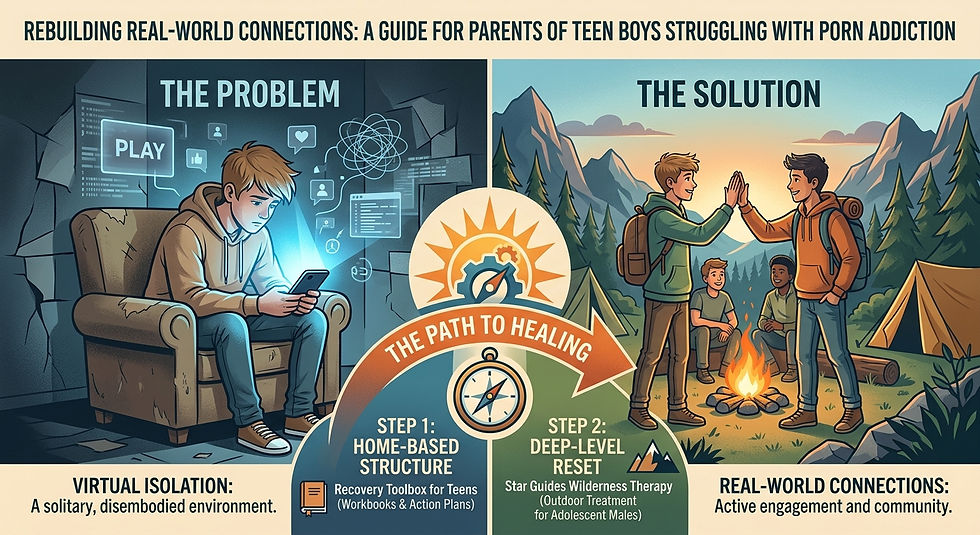
If pornography use is causing significant distress or disrupting daily life, consider consulting a counselor or therapist experienced in adolescent addiction. Early intervention can prevent long-term issues. If your teen is dealing with severe addiction or emotional distress, professional help may be necessary. Therapists specializing in adolescent addiction can offer personalized strategies and counseling. Utilize the Recovery Toolbox for Teens, a comprehensive, structured program designed to provide evidence-based treatment along with meaningful guidance and support for both your adolescent and you as a parent throughout the recovery process.
In situations where there are serious safety risks or unmanageable behavioral issues—such as sexually acting out, having experienced sexual abuse, engaging in high-risk online behaviors, severe mental health crises (including suicidality, self-harm, debilitating anxiety, or depression), or when a teen has become entirely unresponsive to parental authority and the cycle of addictive or compulsive behavior can no longer be safely interrupted at home—an intensive, highly structured therapeutic intervention is often essential. Star Guides Wilderness Therapy offers this level of care: a clinically sophisticated, wilderness-based program specifically designed to stabilize acute risks, restore emotional regulation, and rebuild healthy family dynamics when standard outpatient or home-based approaches are no longer sufficient. This proven next-step intervention provides the containment, expert oversight, and transformative experiences that can mark the turning point toward a successful recovery.



Comments