


Riding the Wave: How "Urge Surfing" Can Help Your Teen Son Beat Pornography Addiction

Discovering that your teenage son is struggling with a pornography addiction is an incredibly heavy moment for a parent. You might feel a mix of shock, fear, or even a sense of failure. If you are navigating this right now, please take a deep breath: you are not a bad parent, and your son is not a broken kid.
In today’s digital age, teen boys are exposed to highly explicit material earlier and more aggressively than any generation before them. The teenage brain is a work in progress; its prefrontal cortex—the area responsible for impulse control and long-term planning—is still developing. When a teen boy experiences stress, boredom, or loneliness, the instant dopamine hit from pornography acts like a high-speed escape hatch.
To help him break this automatic cycle, we have to move past simple white-knuckle willpower or standard internet filters. We need to give him psychological tools that match the intensity of the impulse. One of the most clinically effective techniques for doing exactly that is an intervention called Urge Surfing.
Why Willpower Fails: The Rebound Effect
When parents talk to their struggling teens, the default advice is usually some variation of: "Just say no," "Distract yourself," or "Fight the thought."
While well-intentioned, psychological research shows that actively trying to suppress or fight an intense craving often triggers what is known as the rebound effect. When a teen tries to forcefully push an intrusive thought out of his mind, that thought actually becomes more hyper-salient and intense.
Clinical data indicates that thought suppression and avoidance are heavily associated with increased cravings and higher relapse rates. When he tries to fight the urge head-on, he usually gets exhausted, gives in, and feels a profound sense of shame—which then triggers the desire to use pornography again to numb the shame.
Urge surfing offers a completely different path. Instead of fighting the wave, it teaches him how to ride it until it dissolves.
What is Urge Surfing?
Originally developed by late relapse-prevention pioneer Dr. Alan Marlatt, Urge Surfing is a mindfulness-based technique rooted in a simple but powerful realization: urges are like ocean waves. They start small, ramp up to a peak of intense discomfort, and then naturally subside and wash away onto the shore.
When a teen boy experiences a craving to watch pornography, it feels like the craving will grow forever until he gives in. But biologically, an urge is just a temporary spike of neurochemicals and physical sensations. If left unfed, the peak of an urge typically lasts only about 10 to 30 minutes before breaking.
   INTENSITY OF THE URGE
     ^
     |         [ The Peak ] (Uncomfortable, but temporary!)
     |            /\
     |           /  \
     |          /    \
     |         /      \
     |        /        \
     |_______/__________\________> TIME (Usually 10-30 minutes)
     [ Trigger ]        [ Wave Subsides ]
A substantial body of clinical research has proven that mindfulness-based relapse prevention (MBRP) strategies, including urge surfing, successfully reduce addictive behaviors and cravings by training the brain to tolerate discomfort without reacting. Landmark studies have shown that while urge surfing might not immediately eliminate the feeling of a craving, it drastically changes a person's response to it, significantly reducing the likelihood of acting out. It transforms a compulsive habit into a conscious choice.

Teaching Your Son to Surf the Urge: A 4-Step Guide
You can share this technique with your son during a calm, non-judgmental conversation. Walk him through these four steps so he can practice them the next time an impulse strikes:
1.Acknowledge and Name It: Minute 1.
When the impulse to open a browser window hits, tell him to stop and name it internally: "The urge is here." Rather than panicking, trying to fight it, or shaming himself, he should treat it objectively—like a changing weather pattern or an approaching wave.
2.Locate the Physical Sensations: Minutes 2–5.
Cravings live in the body before they take over the mind. Have him close his eyes and track where the urge is physically manifesting. Is it a tight feeling in his chest? A restless buzzing in his legs? A knot in his stomach? Turning toward the sensation with objective curiosity strips away its emotional power.
3.Focus on Breath Anchoring: Minutes 5–15.
Instruct him to leave the physical sensations alone and focus entirely on his breathing. He should notice the rise and fall of his belly or the cool air entering his nose. This breath is his "surfboard." It keeps him steady and anchored in the present moment while the physical wave peaks around him.
4.Observe the Decline: Minutes 15–30.
As he continues breathing, he will notice that the physical tension begins to change, soften, and eventually recede. He has successfully outlasted the peak of the wave without wiping out.
Building a Complete Path to Recovery
While urge surfing is a phenomenal tool for handling real-time impulses, beating an addiction completely requires a comprehensive structural approach. If your son is deeply entrenched in behavioral patterns, layering supportive clinical interventions can make all the difference.
If you are looking to build a robust recovery track for him, consider incorporating these highly specialized resources:
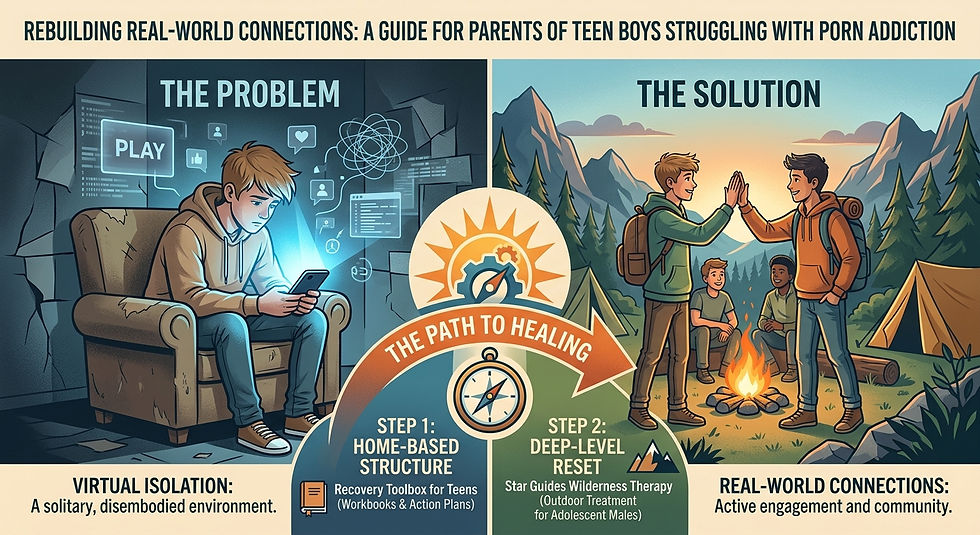
1. The Recovery Toolbox for Teens
To reinforce daily habits, structure is essential. The Recovery Toolbox for Teens is an exceptional workbook and practical resource framework specifically tailored for adolescent dynamics. It helps teen boys map out their personal triggers, build daily accountability routines, and actively practice clinical tools—including urge surfing tracking—right from home. It gives them a tangible blueprint to reference when their thoughts get loud.
2. Star Guides Wilderness Therapy
Sometimes, the digital environment surrounding a teen is too saturated for them to get a clear foothold in recovery. When outpatient therapy isn't enough, Star Guides Wilderness Therapy offers a profoundly transformative intervention. Operating as a specialized outdoor behavioral healthcare program, Star Guides completely removes the digital static and distractions of daily life.
In a safe, therapeutic wilderness setting, expert clinicians work directly with teen boys to address the root causes of pornography addiction, compulsive sexual behaviors, and trauma. The environment fosters deep introspection, builds genuine emotional resilience, and teaches them how to navigate discomfort naturally.
The Takeaway for Parents: Recovery is a marathon of small choices. Your son doesn't have to promise he will never feel an urge again; he just needs to learn how to breathe through the next 20 minutes. With the right mindfulness tools, a structured daily program, and specialized therapeutic support when needed, he can reclaim his focus, his adolescence, and his future.

References
Bowen, S., & Marlatt, A. (2009). Surfing the urge: Brief mindfulness-based intervention for college student smokers. Psychology of Addictive Behaviors, 23(4), 666–671. https://doi.org/10.1037/a0017127
Cited by: 538
Enkema, M. C., Hallgren, K. A., Neilson, E. C., Bowen, S., Bird, E. R., & Larimer, M. E. (2020). Disrupting the path to craving: Acting without awareness mediates the link between negative affect and craving. Psychology of Addictive Behaviors, 34(5), 620–627. https://doi.org/10.1037/adb0000565
Cited by: 30
Hosseini, P. S. (2023). Effects of mindfulness-based relapse prevention therapy on drug craving and emotion regulation of therapeutic community centers clients. Journal of Health and Rehabilitation Sciences, 2(1), e136888.
Cited by: 12
Li, W., Howard, M. O., Garland, E. L., McGovern, P., & Lazar, M. (2017). Mindfulness treatment for substance misuse: A systematic review and meta-analysis. Journal of Substance Abuse Treatment, 75, 62–96. https://doi.org/10.1016/j.jsat.2017.01.008
Cited by: 546
Melero Ventola, A. R., Yela, J. R., Crego, A., & Cortés-Rodríguez, M. (2020). Effectiveness of a mindfulness-based cognitive therapy group intervention in reducing gambling-related craving. Journal of Evidence-Based Psychotherapies, 20(1), 107–134. https://doi.org/10.24193/jebp.2020.1.7
Cited by: 17
Murphy, C. M., & MacKillop, J. (2014). Mindfulness as a strategy for coping with cue-elicited cravings for alcohol: An experimental examination. Alcoholism: Clinical and Experimental Research, 38(4), 1134–1142. https://doi.org/10.1111/acer.12322
Cited by: 60
Ramadas, E., Lima, M. P. d., Caetano, T., Lopes, J., & Dixe, M. d. A. (2021). Effectiveness of mindfulness-based relapse prevention in individuals with substance use disorders: A systematic review. Behavioral Sciences, 11(10), 133. https://doi.org/10.3390/bs11100133
Cited by: 84
Sancho, M., De Gracia, M., Rodríguez, R. C., Mallorquí-Bagué, N., Sánchez-González, J., Trujols, J., Sánchez, I., Jiménez-Murcia, S., & Menchón, J. M. (2018). Mindfulness-based interventions for the treatment of substance and behavioral addictions: A systematic review. Frontiers in Psychiatry, 9, Article 95. https://doi.org/10.3389/fpsyt.2018.00095


Comments